
When Is the Lunar Eclipse in 2026?
The final lunar eclipse of 2026 will take place on Friday, August 28, 2026. It will be a deep partial lunar eclipse, during which a large portion of the Moon will pass through Earth’s dark central shadow, known as the umbra.
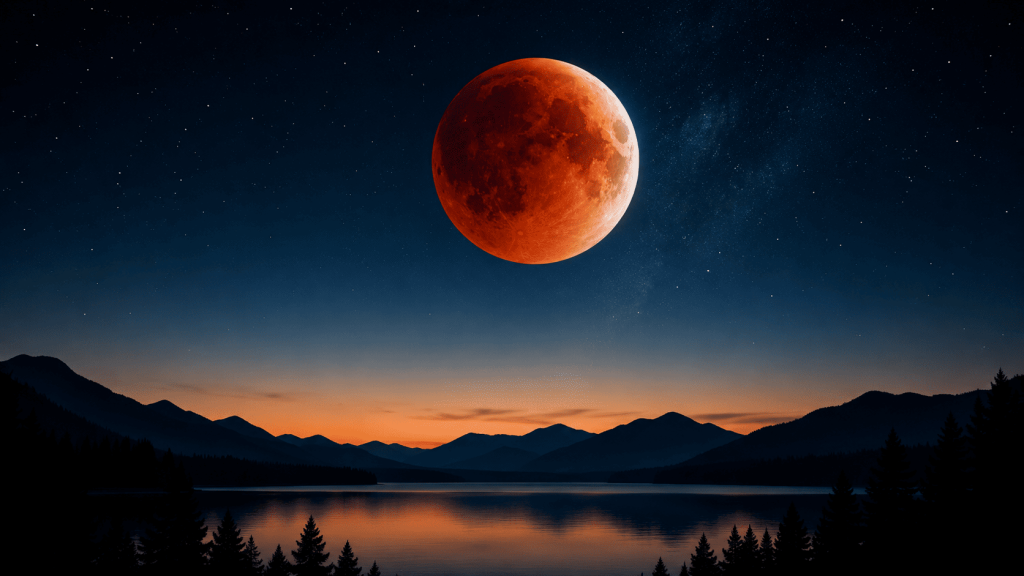
Because a significant part of the Moon may appear reddish or copper-colored, the event could offer a dramatic celestial view.
Lunar Eclipse 2026 Time in India
According to Indian Standard Time (IST), the eclipse timings are approximately:
| Event | Time (IST) |
| Penumbral Eclipse Begins | 6:53 AM |
| Partial Lunar Eclipse Begins | 8:03 AM |
| Maximum Eclipse | Around 9:43 AM |
| Partial Eclipse Ends | Around 11:21 AM |
| Penumbral Eclipse Ends | Around 12:31 PM |
Note: Eclipse timings may vary slightly depending on astronomical calculations and geographical location.
Will the Lunar Eclipse Be Visible in India?
The August 28, 2026 lunar eclipse is not expected to be clearly visible from most parts of India, as the major phases of the eclipse will occur when the Moon may be below the horizon or during daylight hours.
Skywatchers in India may be able to follow the event through online live streams and astronomical observatories.
How Does a Lunar Eclipse Occur?
A lunar eclipse occurs when the Earth moves between the Sun and the Moon, causing Earth’s shadow to fall on the lunar surface.
During a partial lunar eclipse, only a portion of the Moon enters Earth’s darkest shadow. The August 28, 2026 event is expected to be particularly interesting because a large part of the Moon will be affected by Earth’s shadow.
Why Can the Moon Turn Red During an Eclipse?
During a lunar eclipse, Earth’s atmosphere filters sunlight. Shorter blue wavelengths are scattered, while red and orange wavelengths can reach the Moon.
As a result, the eclipsed portion of the Moon may appear red, orange, or copper-colored.
Where Will the August 28, 2026 Lunar Eclipse Be Visible?
The lunar eclipse is expected to be visible from parts of North America, South America, Europe, Africa and Western Asia, depending on local viewing conditions and the timing of moonrise and moonset.
Is It Safe to Watch a Lunar Eclipse?
Yes. A lunar eclipse is completely safe to observe with the naked eye. Unlike a solar eclipse, no special eclipse glasses are required.
However, binoculars or a telescope can provide a clearer and more detailed view of the Moon.
Lunar Eclipse 2026 and Religious Significance
In Hindu traditions, lunar eclipses are associated with religious beliefs and the concept of Sutak Kaal. The observance of Sutak and other rituals can vary depending on whether the eclipse is visible in a particular region.
People are advised to follow their local Panchang or religious traditions for specific guidance regarding Sutak and related practices.
Conclusion
The Lunar Eclipse on August 28, 2026 will be one of the notable astronomical events of the year. As a deep partial lunar eclipse, it may create a striking view of the Moon as a large portion passes through Earth’s shadow.
According to the approximate IST schedule, the eclipse will begin at 6:53 AM, the partial phase will start at 8:03 AM, and the maximum eclipse will occur at approximately 9:43 AM.