
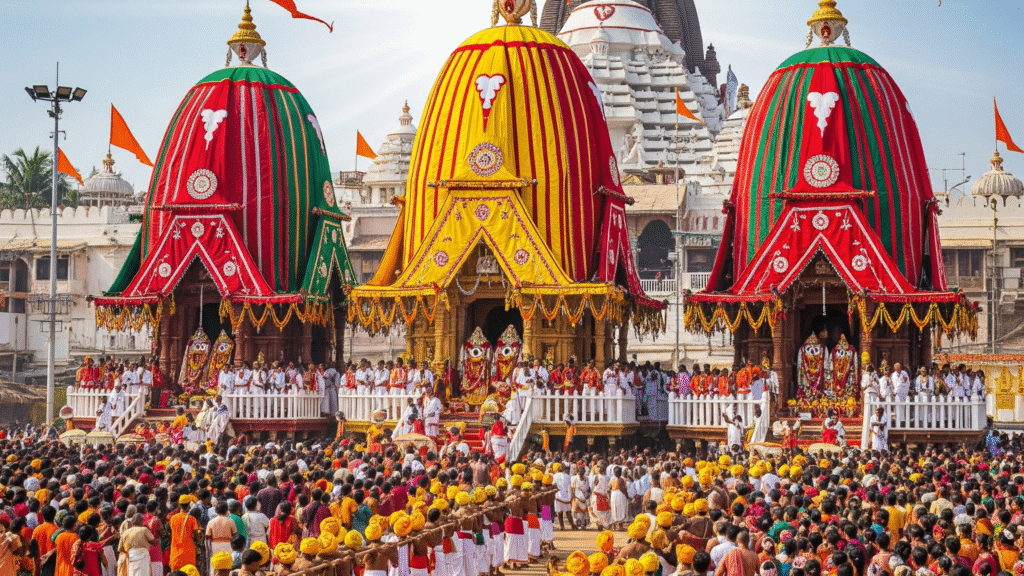
India is a country where festivals and religious celebrations are abundant. Among them, one holds a special significance — the Jagannath Rath Yatra. This grand festival is celebrated annually in the city of Puri, Odisha, with great enthusiasm. The tradition is not only revered across India but also holds a special place in the hearts of devotees around the world. Millions of devotees travel to Puri to pull the chariot of Lord Jagannath and earn spiritual merit.
What is Jagannath Rath Yatra?
Jagannath Rath Yatra is an annual festival in which Lord Jagannath, his elder brother Balabhadra, and sister Subhadra are placed in beautifully decorated chariots and taken from the main temple of Puri to the Gundicha Temple, located about 3 kilometers away. This journey symbolizes Lord Jagannath’s annual summer vacation.
The yatra is held on the Dwitiya tithi (second day) of the Shukla Paksha in the Hindu month of Ashadha (June-July). It is also known as the Gundicha Yatra, Rath Mahotsav, or Car Festival.
Who is Lord Jagannath?
Lord Jagannath is considered a form of Lord Vishnu or Lord Krishna. His unique wooden idol with large round eyes makes him distinct from other deities. The name “Jagannath” literally means “Lord of the Universe”, signifying that he is the master of all creation.
Why is Rath Yatra Celebrated?
This festival holds great religious, cultural, and spiritual importance for several reasons:
- In remembrance of Lord Krishna’s journey to Kurukshetra: It is believed that Lord Krishna, along with Balram and Subhadra, once traveled from Dwarka to Kurukshetra. The Rath Yatra of Puri symbolically re-enacts that journey.
- Opportunity for all to have darshan (sacred glimpse): On regular days, only Hindus are allowed to enter the Jagannath Temple. But on Rath Yatra, the Lord comes out on the streets, giving everyone—regardless of religion, caste, or class—the chance to have his darshan.
- Symbol of devotion: The festival offers devotees a unique opportunity to feel closer to the deity and serve him by pulling his chariot.
What Happens During Rath Yatra?
1. Construction of Chariots:
- About two months before the yatra, three grand chariots are built using wood.
- Each chariot has its unique size, height, and color.
-
- Lord Jagannath’s chariot – Nandighosha (Chakra Dhwaja)
- Lord Balabhadra’s chariot – Taladhwaja
- Goddess Subhadra’s chariot – Darpadalana
2. Pahandi Yatra:
- The deities are ceremonially brought from the sanctum to the chariots in a grand procession called ‘Pahandi’.
- This is a festive scene with devotional songs, drums, conch-blowing, and dancing.
3. Chhera Pahara Ritual:
- This sacred ritual is performed by the King of Puri (Gajapati Raja).
- He sweeps around the chariots and sprinkles holy water, signifying that all are equal in the eyes of God.
4. Pulling of the Chariots:
- A massive crowd pulls the chariots with ropes. It is believed that pulling the Lord’s chariot washes away sins and grants liberation (moksha).
- The deities are taken to the Gundicha Temple, where they stay for 9 days.
5. Bahuda Yatra (Return Journey):
-
After 9 days, the deities return to the main Jagannath Temple. This return journey is known as the Bahuda Yatra.
Where Else is Rath Yatra Celebrated?
While the Rath Yatra in Puri is the oldest and most famous, it is also celebrated in many other parts of India and across the globe:
- Ahmedabad (Gujarat): Known as the second largest Rath Yatra in India.
- Kolkata, Hyderabad, Mumbai, Delhi: Organized by ISKCON temples with grandeur.
- International Celebrations: ISKCON temples in USA, UK, Russia, Australia, South Africa, and other countries also host Rath Yatra festivals.
Spiritual and Social Significance
- Message of Equality: Even kings like the Gajapati sweep in front of the Lord’s chariot—showing that everyone is equal before God.
- Symbol of Universal Brotherhood: The Lord offers darshan to all, promoting unity and harmony among people.
- Opportunity for Seva (Service): Lakhs of devotees participate in pulling the chariot, serving prasad (holy food), and other services—leading to spiritual purification and merit.
Interesting Facts about the Rath Yatra
- The chariots are newly built every year using specific sacred trees.
- During the yatra, the Lord is dressed in a different attire and adorned uniquely.
- It is believed the chariot only moves when the Lord desires.
- Devotional food distribution (Bhandara) and kirtans are held throughout the journey.
Jagannath Rath Yatra is not just a religious festival—it is a cultural, social, and spiritual celebration. It teaches us that all are equal in front of the divine, that service is the highest form of worship, and that devotion should be free from discrimination.
For devotees, this journey is a life-transforming experience where they not only get to see the Lord but also walk with him, serve him, and feel his divine presence.
If you ever get the chance to witness this divine yatra, don’t miss it—because it is not just a sight to behold but a spiritual experience to be felt deep in the heart.