
Chapter 2 – Sankhya Yoga
Shloka 3
klai-byam ma sma gama: partha naitattvayyupapadyate |
kshudram hriday-daurbalyam tyaktvottishtha parantapa || 3||
Simple English Meaning:
Lord Krishna said:
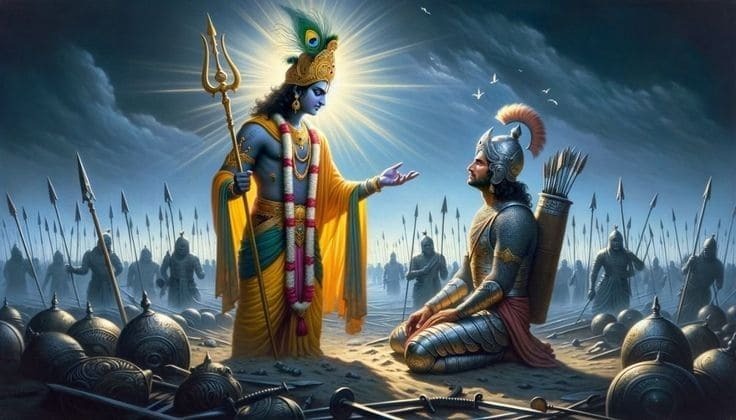
O Partha (Arjuna)! This fear, hesitation, and mental weakness are not appropriate for you. They do not suit your valorous nature. Abandon the smallness and weakness of your heart, recognize the courage and strength within you, and rise, O mighty warrior!
Detailed Explanation:
This shloka comes at a critical moment on the battlefield of Kurukshetra, where Arjuna is overwhelmed by confusion, compassion, and fear. Seeing his relatives, teachers, and friends on both sides, he is immersed in grief and hesitation, unable to perform his duty.
Here, Lord Krishna guides Arjuna to overcome his internal fear and mental weakness:
Klai-byam ma sma gama:
O Arjuna! This fear and hesitation are not suitable for you. Let go of the mental weakness that is holding you back. Such fear or doubt is unworthy of a great warrior and a dharma practitioner.
Naitattvayyupapadyate:
This state of mind is completely inappropriate for the noble Arjuna, the warrior destined to uphold righteousness. Your heart cannot accept such weakness.
Kshudram hriday-daurbalyam tyaktvottishtha parantapa:
Abandon the smallness of heart, fear, and weakness within you. Recognize your inner bravery and courage. Rise and actively perform your duty. O Parantapa (scorcher of enemies), it is your dharma to stand against adharma and confront your foes.
Through this shloka, Lord Krishna motivates Arjuna not only for the battle but also for emotional and mental resilience. It is a call to awaken the hidden courage and sense of duty within him.
Deep Spiritual Significance:
The shloka teaches that when a person is engulfed in fear, hesitation, and weakness, he needs to remember the power, courage, and duty within himself:
- klai-byam (weakness) – represents internal fear and self-doubt more than any external battle.
- tyaktvottishtha (abandon and rise) – emphasizes the need for action, courage, and proactivity in facing life’s challenges.
- parantapa (mighty warrior) – signifies that every individual has inherent bravery and a sense of duty that must be recognized and applied.
This verse shows that life will present challenges and obstacles, but one should not let fear or weakness hinder fulfilling one’s duty. Krishna reminds Arjuna that internal weakness and hesitation must never become obstacles on the path of dharma.
Thus, this shloka is not only about war but also conveys a universal lesson: rise above fear and hesitation, perform your duty, and awaken the mighty warrior within yourself. This is the essence of the Bhagavad Gita.