

Chapter 2 – Sankhya Yoga
Verse 62
Sanskrit Verse
dhyāyato viṣhayān puṁsaḥ saṅgas teṣhūpajāyate |
saṅgāt sañjāyate kāmaḥ kāmāt krodho ’bhijāyate || 62 ||
Simple Meaning
O Arjuna!
When a person keeps thinking about sense objects, attachment to them is born. From attachment arises desire, and from unfulfilled desire, anger is produced.
Detailed Explanation
Continuous Thinking Creates Attachment
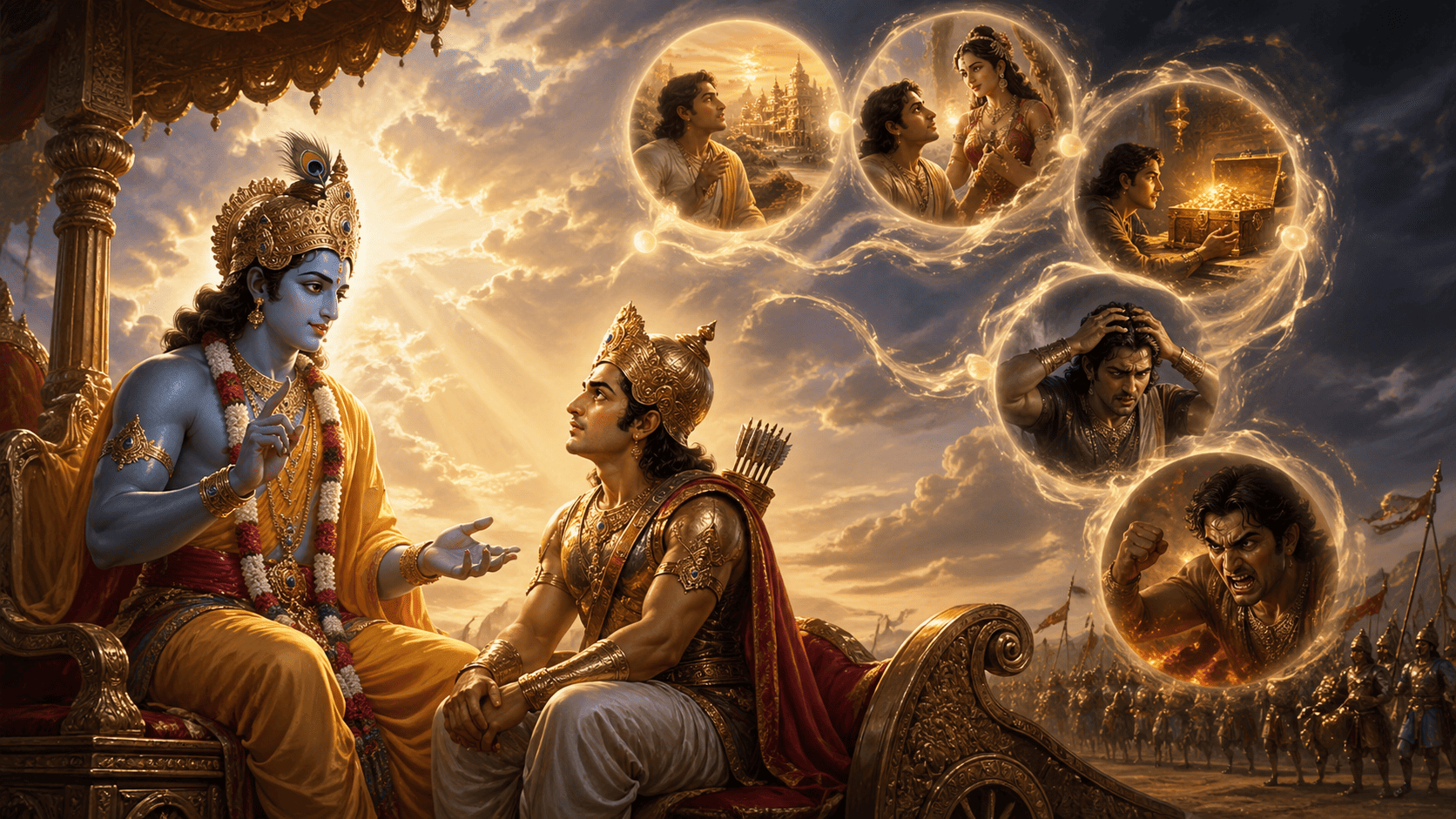
Lord Krishna explains that the journey of downfall begins in the mind itself. When a person repeatedly dwells on sensory pleasures or worldly objects, mental attachment gradually develops.
Attachment Leads to Desire
Once attachment is formed, the mind starts craving those objects. This craving is called kāma (desire)—a strong urge to possess or experience what one is mentally connected to.
Desire Becomes the Root of Disturbance
Desire is not stable. When it is fulfilled, it leads to more craving. When it is blocked or unfulfilled, it turns into frustration and emotional imbalance.
Unfulfilled Desire Turns into Anger
Krishna reveals a crucial psychological truth: when desire is obstructed, it transforms into krodha (anger). This anger is not sudden—it is the result of disappointed expectations.
The Chain Reaction of the Mind
This verse clearly describes a mental progression:
Thought → Attachment → Desire → Anger
It shows how a simple thought, if repeated, can eventually disturb peace of mind.
Power of Mental Focus
What we repeatedly think about becomes emotionally significant. The mind strengthens whatever it focuses on, whether positive or negative.
Importance of Awareness
Krishna is teaching Arjuna to be aware of early mental stages. If thoughts are controlled at the beginning, the entire chain of suffering can be avoided.
Key Points
- Thinking about sense objects creates attachment
- Attachment gives rise to desire
- Unfulfilled desire leads to anger
- The mind builds a chain reaction of emotions
- Early awareness can prevent mental disturbance
Profound Spiritual Meaning
This verse explains the psychology of suffering. It shows that external situations are not the root cause of anger or desire—the mind itself creates the cycle through repeated thinking and attachment.
True control is not suppression but awareness at the level of thought.
Word-by-Word Meaning
- dhyāyataḥ – while contemplating
- viṣhayān – sense objects
- puṁsaḥ – of a person
- saṅgaḥ – attachment
- teṣhu – in them
- upajāyate – arises
- saṅgāt – from attachment
- sañjāyate – is born
- kāmaḥ – desire
- kāmāt – from desire
- krodhaḥ – anger
- abhijāyate – arises
Message of the Shloka
The mind is the origin of both desire and anger. By controlling thoughts at their root and reducing attachment, one can break the chain that leads to emotional disturbance and inner conflict.