

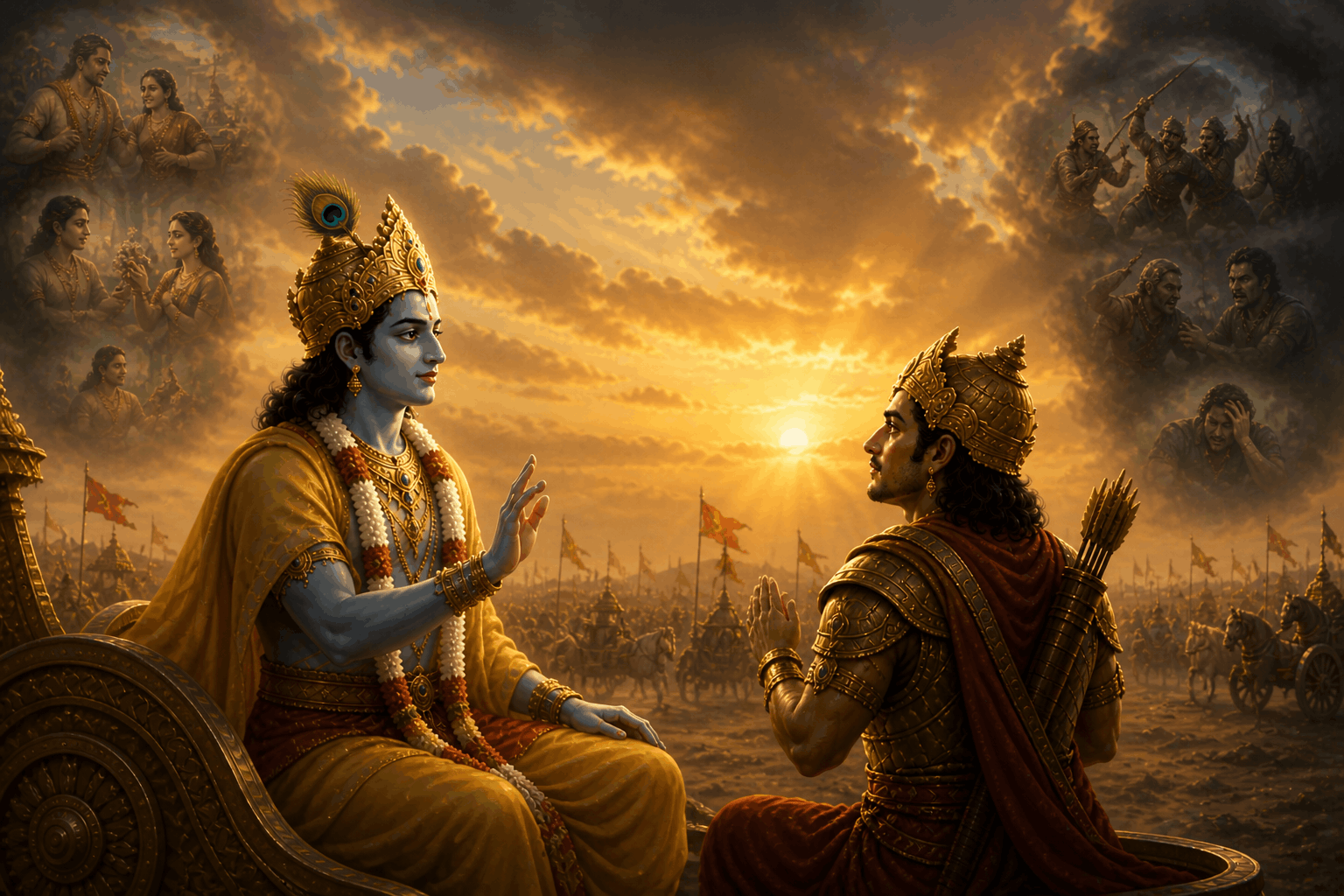
Chapter 2 – Sankhya Yoga
Verse 64
Sanskrit Verse
rāga-dveṣha-viyuktais tu viṣhayān indriyaiśh charan
ātma-vaśhyair-vidheyātmā prasādam adhigachchhati
Simple Meaning
O Arjuna!
One who moves among sense objects free from attachment (rāga) and aversion (dveṣha), with controlled senses and a disciplined mind, attains inner peace and serenity.
Detailed Explanation
Freedom from Attachment and Aversion
Krishna explains that human suffering arises from attachment (rāga) and aversion (dveṣha).
People either cling to what they like or reject what they dislike.
But a wise person rises above both, maintaining balance in all situations.
Living in the World with Balance
Krishna does not ask one to abandon the world.
Instead, he teaches how to live in it wisely.
A person can engage with sense objects,
but without emotional dependence or hatred.
Control of Senses and Mind
The key to this teaching is self-control.
When the senses are under control and guided by a disciplined mind,
they no longer disturb inner stability.
Such a person acts consciously, not impulsively.
Disciplined Inner Self
“Vidheyātmā” refers to a person whose mind is trained and obedient.
They are not controlled by desires, but instead guide their own actions with awareness.
Attainment of Inner Peace (Prasāda)
Krishna concludes that such a balanced and self-controlled person attains prasāda,
which means deep inner peace, clarity, and contentment.
This peace is not temporary—it is stable and lasting.
Key Points
- Freedom from attachment and aversion is essential
- One can live in the world without being bound by it
- Control of senses leads to mental stability
- Discipline of mind brings clarity and peace
- Inner peace (prasāda) is the ultimate result
Profound Spiritual Meaning
This verse teaches that liberation is not about escaping life,
but about transforming how we experience it.
When a person is free from emotional extremes and has mastery over the mind,
they experience a natural state of peace.
Krishna shows that true happiness comes from inner balance, not external conditions.
Word-by-Word Meaning
Rāga-dveṣha-viyuktaḥ – Free from attachment and aversion
Tu – But
Viṣhayān – Sense objects
Indriyaiḥ – Through the senses
Charan – Moving / engaging
Ātma-vaśhyaiḥ – With self-controlled senses
Vidheyātmā – Disciplined mind
Prasādam – Peace / serenity
Adhigachchhati – Attains
Message of the Shloka
A person who lives with self-control, free from attachment and aversion, attains true inner peace.
Krishna teaches that balance, discipline, and detachment are the keys to a calm and fulfilled life.