

Chapter 4 – Jnana Karma Sannyasa Yoga
Verse 4
Sanskrit Verse
Arjuna Uvācha:
Aparaṁ bhavato janma paraṁ janma Vivasvataḥ ।
Katham etad vijānīyāṁ tvam ādau proktavān iti ॥4॥
Simple Meaning
Arjuna said:
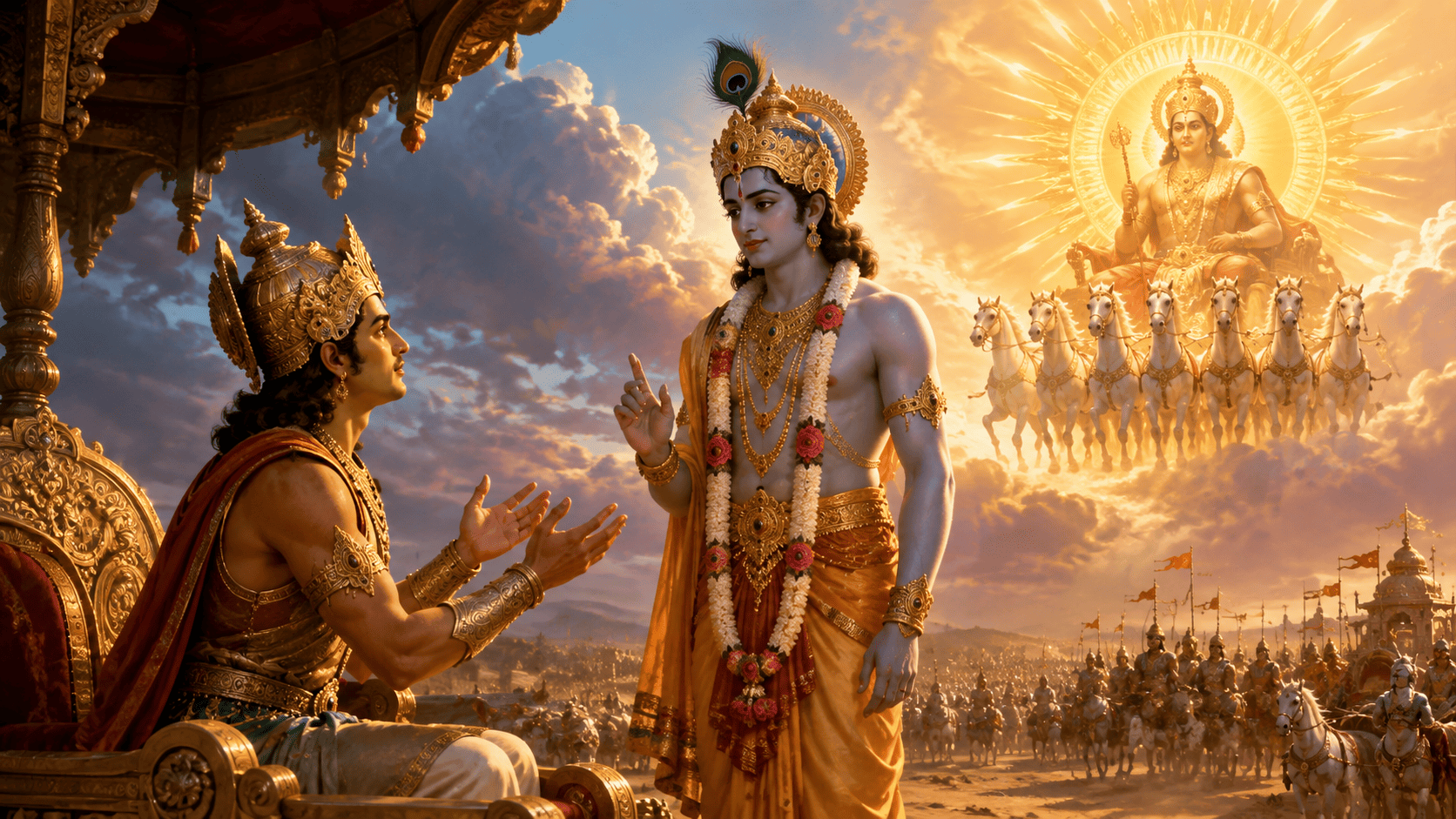
O Lord Krishna, Your birth is in the present time, while the birth of Vivasvan, the Sun God, occurred long before Yours. How am I to understand that You taught this eternal Yoga to Vivasvan in the beginning?
Detailed Explanation
Arjuna’s Question About the Ancient Teaching
In this verse, Arjuna respectfully asks Lord Krishna about something that appears difficult to understand.
In the previous verses, Lord Krishna explained that He had originally taught this ancient Yoga to Vivasvan, the Sun God, who then passed it down through the spiritual tradition.
Arjuna now wonders how this could have happened because Lord Krishna appears to have been born much later than Vivasvan.
The Difference Between Krishna and Vivasvan’s Birth
Arjuna points out that Lord Krishna’s birth appears to be in the present age, while Vivasvan existed long before Him.
From the ordinary human point of view, a person who is born later cannot teach something to someone who existed earlier. Therefore, Arjuna sincerely asks Krishna how he should understand this statement.
His question opens the way for Lord Krishna to explain His divine nature and the mystery of His appearance in the world.
Arjuna’s Sincere Curiosity
Arjuna is not asking this question out of disrespect or disbelief. He is sincerely trying to understand the deeper meaning of Krishna’s words.
This demonstrates that a genuine spiritual seeker can ask questions while maintaining faith and respect toward the teacher.
Arjuna’s willingness to express his doubt allows Lord Krishna to provide a deeper explanation of His eternal and divine nature.
The Divine Nature of Lord Krishna
Arjuna’s question points toward an important distinction between an ordinary living being and the Supreme Lord.
Ordinary beings take birth according to the results of their past actions, whereas the appearance of the Supreme Lord is divine. Lord Krishna later explains that His birth and activities are not ordinary.
Thus, this verse prepares Arjuna to understand that Krishna’s existence cannot be judged only through ordinary material concepts of birth and time.
The Importance of Understanding God’s Divine Appearance
The question raised by Arjuna becomes important for understanding the nature of the Supreme Lord.
Lord Krishna is present before Arjuna in a human-like form, but His existence is eternal. His appearance in the world is connected with His divine purpose and His relationship with Dharma.
Therefore, Arjuna wants to know how Krishna could have existed in the beginning and instructed Vivasvan.
Spiritual Knowledge and Honest Questions
This verse teaches that sincere questioning is an important part of spiritual learning.
Arjuna does not ignore his confusion. Instead, he approaches Lord Krishna and asks for clarification. A sincere seeker should similarly seek proper understanding rather than accepting or rejecting spiritual teachings without reflection.
When questions are asked with humility and sincerity, they can lead to deeper spiritual knowledge.
Jnana Karma Sannyasa Yoga in Practice
This verse reminds us that spiritual wisdom requires both faith and understanding.
The path of Jnana Karma Sannyasa Yoga encourages a person to develop spiritual knowledge, understand the nature of the Supreme, and perform duties with the right consciousness.
By understanding the difference between ordinary material existence and divine consciousness, a seeker can gradually overcome ignorance and develop deeper faith in the Supreme.
Key Points
- Arjuna asks Lord Krishna about His statement regarding Vivasvan.
- Krishna’s apparent birth occurred later than the existence of Vivasvan.
- Arjuna wants to understand how Krishna could have taught this Yoga to Vivasvan in the beginning.
- Arjuna asks this question with sincerity and respect.
- His question opens the way for understanding Krishna’s divine nature.
- The appearance of the Supreme Lord is different from the ordinary birth of living beings.
- Sincere questioning is an important part of spiritual learning.
- Understanding the divine nature of Krishna helps a seeker progress in spiritual knowledge.
Profound Spiritual Meaning
This verse represents an important moment in the dialogue between Arjuna and Lord Krishna. Arjuna observes an apparent contradiction between Krishna’s present birth and His statement that He taught the ancient Yoga to Vivasvan.
The deeper significance of Arjuna’s question is that it leads to the revelation of Lord Krishna’s eternal and divine nature. Ordinary living beings take birth according to material laws, while the Supreme Lord appears in the world according to His divine will and purpose.
The verse also teaches that spiritual understanding grows through sincere questioning, humility, faith, and proper guidance. Arjuna’s question allows Krishna to explain the mystery of His divine appearance and His eternal relationship with the world.
Word-by-Word Meaning
Arjuna Uvācha – Arjuna said
Aparam – Later, subsequent
Bhavataḥ – Your
Janma – Birth
Param – Earlier, prior
Janma – Birth
Vivasvataḥ – Of Vivasvan, the Sun God
Katham – How
Etat – This
Vijānīyām – May I understand, know
Tvam – You
Ādau – In the beginning
Proktavān – Spoke, taught
Iti – Thus, in this way
Message of the Verse
Arjuna respectfully asks Lord Krishna how He could have taught the ancient Yoga to Vivasvan in the beginning when Krishna’s birth appears to have occurred much later than the birth of the Sun God. This question leads toward the deeper understanding of Krishna’s eternal and divine nature. The verse teaches us that sincere questions, faith, humility, and proper guidance are essential for understanding profound spiritual truths.