

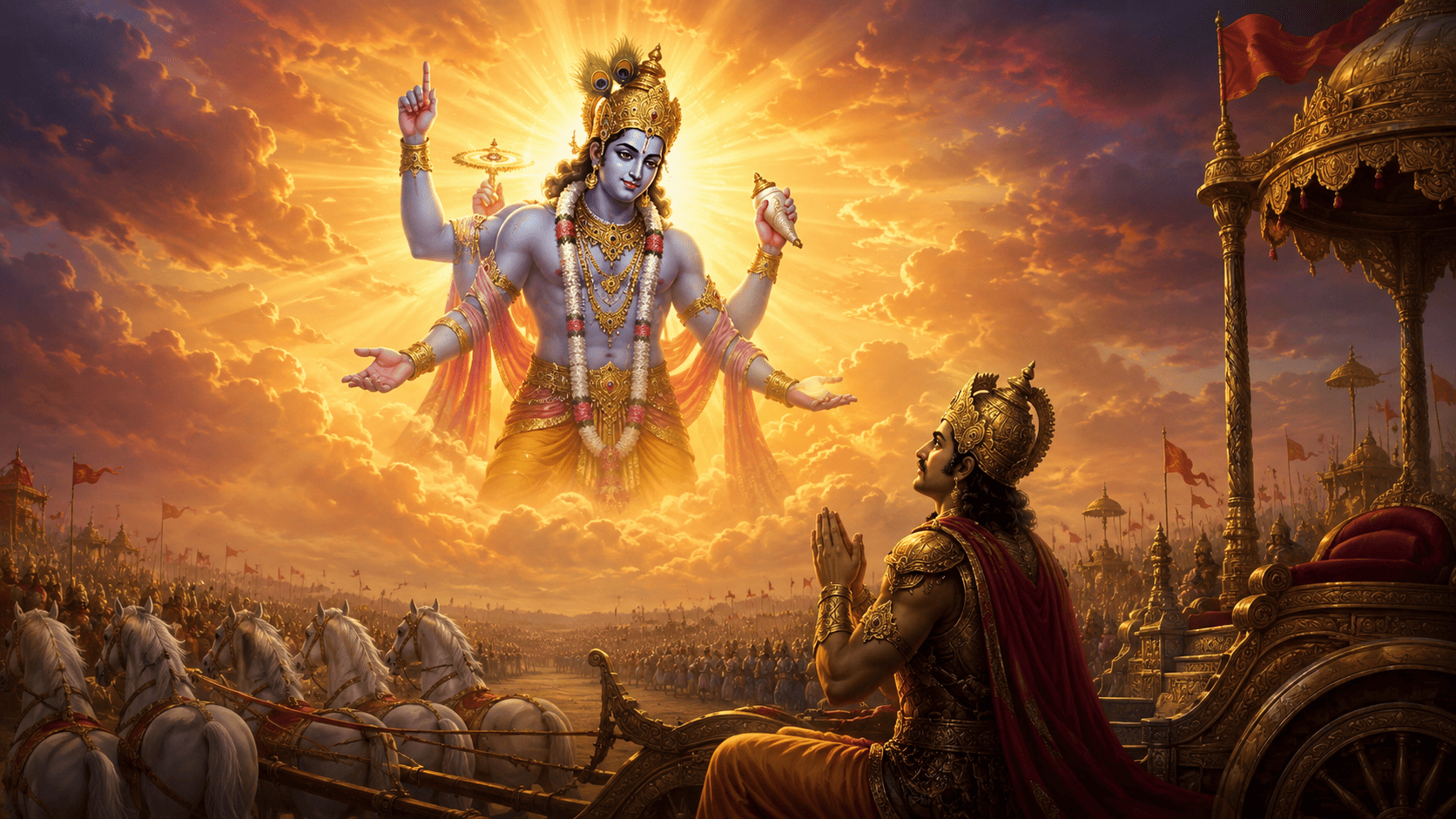
Chapter 4 – Jnana Karma Sannyasa Yoga
Verse 7
Sanskrit Verse
Śhrī Bhagavān Uvācha:
Yadā yadā hi dharmasya glānir bhavati Bhārata ।
Abhyutthānam adharmasya tadātmānaṁ sṛijāmy aham ॥7॥
Simple Meaning
Lord Krishna said:
O descendant of Bharata, whenever there is a decline in righteousness and a rise in unrighteousness in the world, at that time I manifest Myself.
Detailed Explanation
Lord Krishna Reveals the Purpose of His Divine Manifestation
In this verse, Lord Krishna explains when and why He manifests Himself in the world.
Whenever righteousness, truth, justice, and moral values decline, while unrighteousness and injustice begin to increase, the balance of the world is disturbed.
At such times, the Supreme Lord manifests Himself through His divine power to restore righteousness and guide living beings toward the path of dharma.
The Decline of Dharma
The word dharma refers to righteousness, truth, duty, moral conduct, and the principles that maintain harmony in individual and social life.
When people move away from truth, compassion, justice, self-discipline, and their righteous duties, dharma begins to decline.
Lord Krishna explains that such a decline in righteousness is one of the circumstances in which He manifests Himself.
The Rise of Adharma
Adharma means conduct that goes against righteousness and moral principles.
When injustice, cruelty, dishonesty, selfishness, oppression, and immoral behavior become increasingly powerful, adharma rises.
Lord Krishna assures Arjuna that when unrighteousness becomes dominant and threatens the balance of dharma, the Supreme Lord manifests Himself for a divine purpose.
Lord Krishna Appears Through His Divine Power
Lord Krishna’s manifestation in the world is different from the ordinary birth of a living being.
As explained in the previous verse, the Lord is eternal and unborn. He does not appear in the world because of karma or material compulsion.
Instead, He manifests Himself through His own divine power according to His will and purpose.
The Difference Between Divine Manifestation and Ordinary Birth
Ordinary living beings take birth according to their previous actions and karmic consequences.
The Supreme Lord, however, is not bound by karma. His appearance is voluntary and divine.
Therefore, the manifestation of Lord Krishna should not be understood as an ordinary material birth. It is a divine appearance intended to fulfill a higher spiritual purpose.
Restoring Dharma in the World
One of the important purposes of the Lord’s manifestation is to restore righteousness.
When dharma becomes weak, the Lord provides divine guidance and establishes the principles of truth and righteous conduct.
Through His teachings and divine actions, He shows humanity the importance of following the path of righteousness even during difficult circumstances.
Protection of the Moral and Spiritual Order
Dharma is not merely a set of external religious practices. It represents the moral and spiritual order that helps individuals and society live according to truth and higher principles.
When this order is seriously disturbed, the Lord’s divine manifestation helps restore balance and reminds humanity of its spiritual responsibilities.
Connection with the Previous Verse
In Verse 6, Lord Krishna explained that although He is unborn, eternal, and the Supreme Lord of all beings, He manifests Himself through His own divine power.
Verse 7 now explains when this divine manifestation takes place.
Whenever there is a decline of dharma and an increase of adharma, the Lord manifests Himself. In the following verse, Krishna further explains the purposes of His divine appearance.
Jnana Karma Sannyasa Yoga in Practice
This verse also has an important message for everyday life.
The path of Jnana Karma Sannyasa Yoga encourages a seeker to perform their duties with spiritual understanding and without selfish attachment.
A person does not need to wait for external circumstances to change before following dharma. By practicing truthfulness, compassion, self-discipline, justice, and selfless action in daily life, an individual contributes to the preservation of righteousness.
Understanding this verse inspires a seeker to remain committed to dharma even when circumstances around them become difficult.
Key Points
- Lord Krishna manifests Himself when dharma declines.
- He appears when adharma begins to rise.
- Dharma represents righteousness, truth, duty, justice, and moral conduct.
- Adharma represents actions and values that oppose righteousness.
- Lord Krishna’s manifestation is divine and not caused by karma.
- The Lord is not controlled by material nature.
- His appearance serves a higher spiritual purpose.
- The manifestation of the Lord helps restore righteousness and balance.
- The Lord’s divine appearance is different from the ordinary birth of living beings.
- This verse gives seekers the courage to remain committed to dharma even during difficult times.
Profound Spiritual Meaning
This verse reveals one of the central teachings about the divine manifestation of Lord Krishna. Whenever righteousness declines and unrighteousness becomes powerful, the Supreme Lord manifests Himself to restore the balance of dharma.
The deeper message is that when truth, righteousness, and spiritual values become weak, the divine principle of dharma is restored through the Supreme Lord’s intervention and guidance. The Lord’s manifestation is not caused by material necessity or karma but takes place through His own divine power.
This teaching also encourages human beings to recognize their own responsibility toward dharma. A person who follows truth, performs their duties sincerely, avoids selfishness, and acts for the welfare of others becomes an instrument in preserving righteousness.
By developing spiritual knowledge, performing selfless actions, and cultivating devotion to the Supreme, a seeker can remain steady on the path of dharma and gradually progress toward Self-realization and liberation.
Word-by-Word Meaning
Śhrī Bhagavān Uvācha – The Supreme Lord said
Yadā yadā – Whenever, whenever
Hi – Certainly, indeed
Dharmasya – Of righteousness
Glāniḥ – Decline, deterioration
Bhavati – Occurs, takes place
Bhārata – O descendant of Bharata, Arjuna
Abhyutthānam – Rise, increase
Adharmasya – Of unrighteousness
Tadā – Then, at that time
Ātmānam – Myself, My own divine form
Sṛijāmi – I manifest, I create
Aham – I
Message of the Verse
Lord Krishna teaches Arjuna that whenever dharma declines and adharma rises, He manifests Himself in the world through His divine power. His appearance is not an ordinary birth caused by karma, but a divine manifestation with a higher spiritual purpose.
This verse teaches us that truth, righteousness, and moral values must be protected even when difficult circumstances arise. It also reminds us that the Supreme Lord manifests Himself when the balance of dharma is seriously disturbed.
By developing spiritual knowledge, devotion, and selfless action, a seeker can remain committed to righteousness and contribute to the preservation of dharma. This understanding helps a person rise above selfish desires, strengthen spiritual awareness, and move toward Self-realization and liberation.