
Chapter 4 – Jnana Karma Sannyasa Yoga
Verse 9
Sanskrit Verse
Janma karma cha me divyam evaṁ yo vetti tattvataḥ ।
Tyaktvā dehaṁ punar janma naiti mām eti so ’rjuna ॥9॥
Simple Meaning
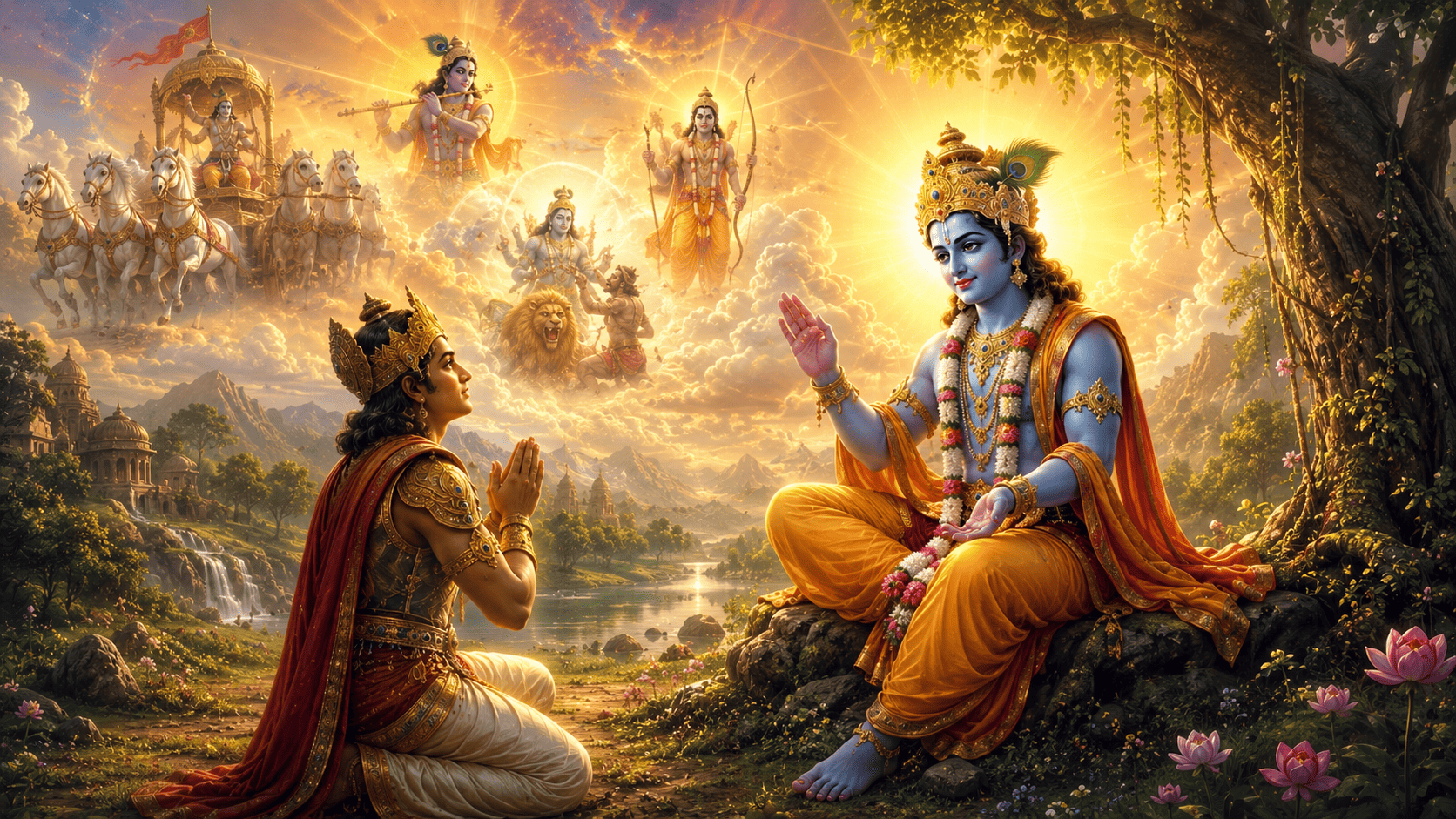
Lord Krishna said:
O Arjuna, one who truly understands the divine nature of My birth and activities does not take birth again after leaving the body, but attains Me.
Detailed Explanation
The Divine Nature of Lord Krishna’s Birth and Actions
In this verse, Lord Krishna reveals an important spiritual truth about His divine appearance and activities.
In the previous verses, Krishna explained that He manifests Himself whenever dharma declines and adharma rises. He further explained that He appears to protect the righteous, destroy the influence of wickedness, and re-establish dharma.
Now, in Verse 9, Lord Krishna explains the spiritual result of truly understanding the divine nature of His birth and actions.
One who understands that the Lord’s appearance and activities are divine and transcendental does not remain bound to the ordinary cycle of birth and death.
Lord Krishna’s Birth Is Divine
The word divyam means divine, transcendental, and beyond ordinary material limitations.
The birth of an ordinary living being takes place according to karma and the consequences of previous actions. A soul accepts another body due to its accumulated desires and karmic reactions.
Lord Krishna, however, is not forced to take birth because of karma. As explained earlier, He is eternal, unborn, and independent.
His appearance in the world takes place through His own divine power and according to His divine will.
Therefore, the Lord’s birth should not be understood as an ordinary material birth.
The Lord’s Actions Are Also Divine
Not only is the Lord’s birth divine, but His karma, or activities, are also divine.
Ordinary beings perform actions because of desires, needs, attachments, and the influence of karma. Such actions often create further consequences and bondage.
The actions of the Supreme Lord are completely free from selfish desire and karmic bondage. His activities are performed for divine purposes, including the protection of the righteous, the restoration of dharma, and the spiritual welfare of living beings.
Understanding the divine purpose behind the Lord’s actions helps a seeker develop a deeper spiritual vision.
The Meaning of “Tattvataḥ”
Lord Krishna says that one must understand His divine birth and activities tattvataḥ, meaning “in truth” or “according to reality.”
This does not simply mean knowing stories about Lord Krishna or having intellectual information about His life.
To understand Him tattvataḥ means to recognize His divine nature, His transcendental position, and the spiritual purpose behind His appearance and actions.
Such understanding develops through sincere spiritual inquiry, reflection, devotion, and the cultivation of genuine spiritual knowledge.
Freedom from Rebirth
Lord Krishna states that a person who truly understands His divine nature, after giving up the present body, does not take birth again.
Ordinary living beings continue through the cycle of birth and death because of karma, desires, attachments, and ignorance.
Spiritual realization gradually frees a seeker from these bindings.
When a person develops genuine understanding of the Supreme Lord and establishes a deep spiritual connection with Him, the individual moves beyond material attachment and progresses toward liberation.
Attaining the Supreme Lord
The words mām eti mean “he attains Me.”
Attaining the Supreme Lord represents the highest spiritual goal. It refers to reaching a state beyond the temporary cycle of material existence and becoming established in spiritual realization.
The verse therefore presents liberation not merely as freedom from suffering, but as the positive attainment of the Supreme Reality.
Through genuine knowledge, devotion, and spiritual surrender, the seeker moves closer to this ultimate goal.
Knowledge and Devotion Together
This verse highlights the importance of spiritual knowledge, but this knowledge is not merely theoretical.
True understanding of the Lord’s divine nature naturally inspires faith, devotion, humility, and surrender.
Knowledge helps a person understand who the Lord is, while devotion creates a living spiritual relationship with Him.
When knowledge and devotion work together, the seeker becomes less attached to selfish desires and increasingly focused on spiritual realization.
Connection with the Previous Verses
Verses 7 and 8 explain the circumstances and purpose of the Lord’s divine manifestation.
Verse 7 explains that the Lord manifests whenever dharma declines and adharma rises.
Verse 8 explains that He appears to protect the righteous, destroy the influence of wickedness, and re-establish dharma.
Verse 9 now explains the spiritual benefit of understanding the divine nature of the Lord’s appearance and activities.
One who understands the Lord’s divine birth and actions in their true spiritual nature becomes free from the cycle of repeated birth and attains the Supreme Lord.
Jnana Karma Sannyasa Yoga in Practice
This verse offers an important lesson for everyday spiritual practice.
A seeker should not merely perform religious or spiritual activities mechanically. The purpose of spiritual practice is to develop genuine understanding and transform one’s consciousness.
The path of Jnana Karma Sannyasa Yoga teaches that knowledge should guide one’s actions and help free the mind from selfish attachment.
By studying spiritual wisdom, performing duties selflessly, developing devotion, and offering one’s actions to the Supreme, a person gradually becomes free from karmic bondage.
The example of Lord Krishna’s divine activities also teaches us to perform our responsibilities without selfish motives and with a higher purpose.
Key Points
- Lord Krishna’s birth and activities are divine and transcendental.
- The Lord does not appear because of karmic bondage.
- His manifestation takes place through His own divine power and will.
- The Lord’s activities are performed for the protection of dharma and the welfare of living beings.
- Tattvataḥ means understanding the Lord’s divine nature in truth.
- True spiritual understanding is more than intellectual knowledge.
- One who truly understands the Lord’s divine birth and activities becomes free from repeated birth.
- Liberation involves attaining the Supreme Lord.
- Spiritual knowledge and devotion together help transform consciousness.
- Selfless action and freedom from attachment support spiritual progress.
Profound Spiritual Meaning
This verse reveals that liberation is connected with a genuine understanding of the divine nature of the Supreme Lord.
Lord Krishna’s appearance and activities are not limited by ordinary material laws. He manifests through His divine power for the welfare of living beings and the restoration of dharma.
The deeper message is that when a seeker understands the transcendental nature of the Lord and develops a genuine spiritual relationship with Him, the consciousness gradually rises above ignorance, selfish attachment, and karmic bondage.
The phrase “punar janma naiti” gives the assurance that spiritual realization leads beyond the repeated cycle of birth and death.
However, this realization is not merely the accumulation of information. It involves an inner transformation through spiritual knowledge, devotion, selfless action, and surrender to the Supreme.
By overcoming ignorance and attachment, the seeker gradually moves toward freedom and ultimately attains the Supreme Lord.
Word-by-Word Meaning
Janma – Birth, divine appearance
Karma – Actions, activities
Cha – And
Me – My
Divyam – Divine, transcendental
Evam – Thus, in this way
Yaḥ – One who
Vetti – Knows, understands
Tattvataḥ – In truth, according to reality
Tyaktvā – Having given up, abandoning
Deham – The body
Punar janma – Repeated birth, rebirth
Na – Not
Eti – Attains, obtains
Mām – Me
Eti – Attains
Saḥ – That person
Arjuna – O Arjuna
Message of the Verse
Lord Krishna teaches that one who truly understands the divine nature of His birth and activities does not take birth again after leaving the present body but attains Him.
This verse reminds us that the Lord’s appearance is not an ordinary birth caused by karma. His manifestation and actions are divine and are performed for the protection of dharma and the spiritual welfare of living beings.
By developing spiritual knowledge, devotion, selfless action, and surrender, a seeker can gradually rise above ignorance and karmic attachment.
The ultimate message of this verse is that genuine understanding of the Supreme Lord leads the seeker beyond the cycle of repeated birth and death and toward spiritual realization and liberation.