
Chapter 3 – Karma Yoga
Verse 42
Sanskrit Verse
Indriyāṇi parāṇy āhur indriyebhyaḥ paraṁ manaḥ ।
Manasas tu parā buddhir yo buddheḥ paratas tu saḥ ॥42॥
Simple Meaning
Lord Krishna said:
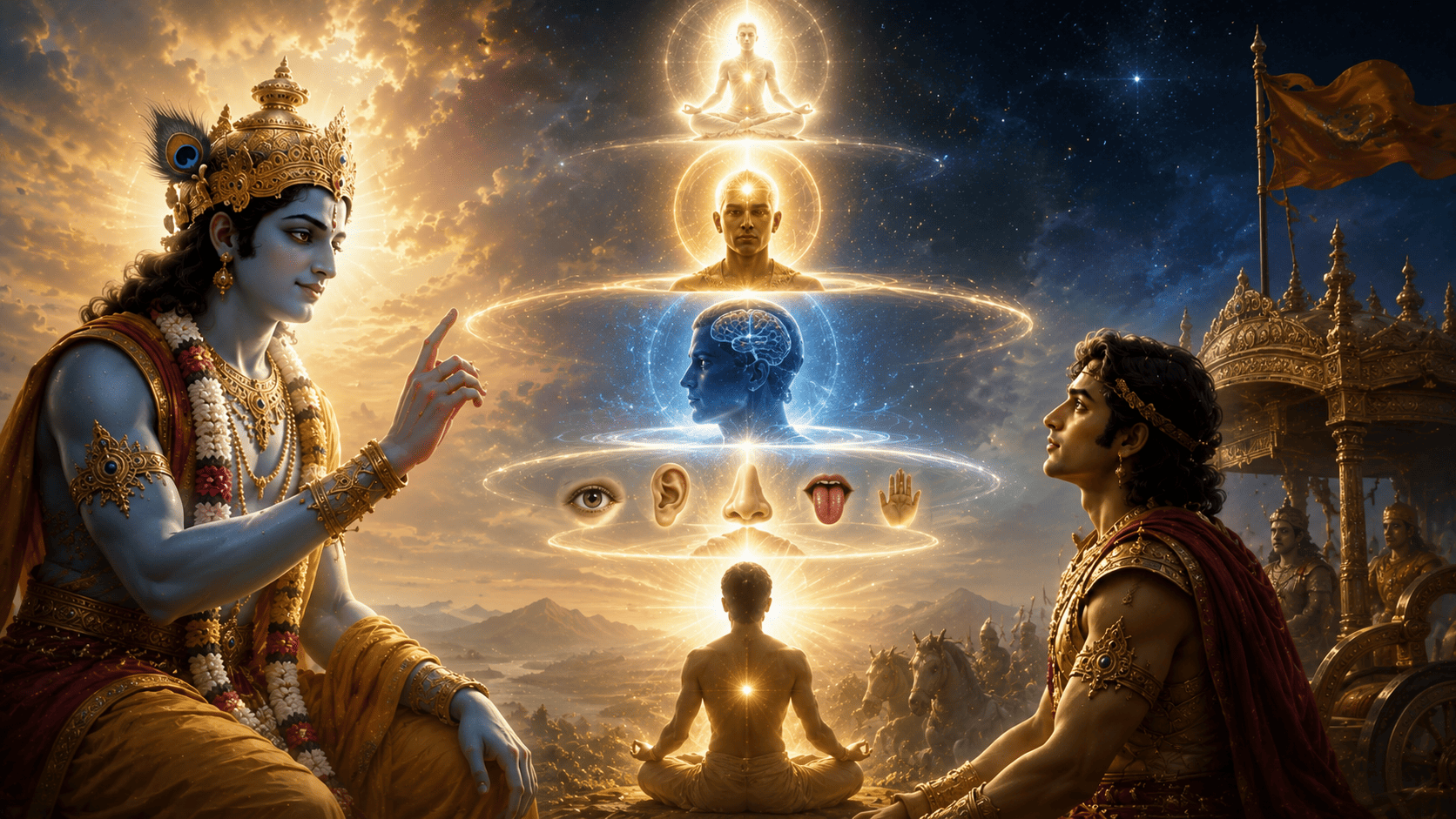
O Arjuna, the senses are considered superior to the physical body, the mind is superior to the senses, the intellect is superior to the mind, and beyond the intellect is the Self (Ātman), which is the highest reality within.
Detailed Explanation
The Hierarchy of Human Nature
In this verse, Lord Krishna explains the inner hierarchy that exists within every human being.
He teaches that the body is governed by the senses, the senses are directed by the mind, the mind is guided by the intellect, and above all these is the eternal Self (Ātman).
Understanding this order helps a seeker recognize where true strength and spiritual authority reside.
The Senses Are Superior to the Body
The physical body functions through the senses.
Without sight, hearing, touch, taste, and smell, the body cannot properly experience the external world.
The senses gather information and connect the individual with worldly objects.
Therefore, Lord Krishna says the senses are superior to the body because they direct its interactions with the world.
The Mind Governs the Senses
Although the senses receive impressions, it is the mind that interprets and responds to them.
The mind creates likes and dislikes, attachments and aversions.
When the mind is disturbed, even disciplined senses may become restless.
When the mind is peaceful, the senses naturally remain under control.
Therefore, the mind is superior to the senses.
The Intellect Guides the Mind
The intellect (Buddhi) possesses the power of discrimination and wisdom.
It distinguishes between right and wrong, permanent and temporary, and beneficial and harmful.
A purified intellect guides the mind toward righteous actions and spiritual growth.
However, if the intellect becomes clouded by attachment and selfish desire, wrong decisions may follow.
For this reason, the intellect is considered superior to the mind.
The Self Is Supreme
Beyond the intellect lies the Self (Ātman), the true identity of every living being.
The Self is eternal, pure, unchanging, and untouched by the activities of the body and mind.
When a person realizes the Self, fear, attachment, and ignorance gradually disappear.
This realization is the highest goal of spiritual life and the foundation of lasting peace.
Karma Yoga in Practice
Karma Yoga teaches that spiritual growth comes by bringing the senses, mind, and intellect under the guidance of the Self.
When actions are performed without selfish attachment and are offered to God, the mind becomes purified.
Meditation, devotion, self-discipline, and selfless service strengthen the intellect and help reveal the presence of the Self.
As inner awareness grows, one becomes free from the influence of desire and experiences true inner harmony.
The Path to Self-Realization
Lord Krishna shows that victory over life begins within.
A seeker should first regulate the senses, then calm the mind, strengthen the intellect through spiritual wisdom, and finally realize the eternal Self.
Once the Self is realized, external circumstances no longer disturb inner peace.
This realization leads to freedom from ignorance, lasting happiness, and ultimate liberation.
Key Points
- The senses are superior to the physical body.
- The mind is superior to the senses.
- The intellect is superior to the mind.
- The Self (Ātman) is superior to the intellect.
- True strength comes from realizing the Self.
- A purified intellect guides the mind toward righteousness.
- Karma Yoga helps harmonize the senses, mind, and intellect.
- Devotion, meditation, and self-discipline lead to Self-realization.
- Realizing the Self brings lasting peace and liberation.
Profound Spiritual Meaning
This verse reveals the inner structure of human existence and teaches that the highest power within every person is not the body, the senses, the mind, or even the intellect, but the eternal Self.
Spiritual progress becomes possible when each lower faculty is guided by the one above it, until the intellect itself is surrendered to the wisdom of the Self.
Lord Krishna teaches that by practicing Karma Yoga, cultivating devotion, developing discrimination, and realizing one’s true spiritual identity, a seeker rises above worldly attachments and discovers everlasting peace, divine wisdom, and ultimate liberation.
Word-by-Word Meaning
Indriyāṇi – The senses
Parāṇi – Superior
Āhuḥ – Are said to be
Indriyebhyaḥ – Than the senses
Param – Higher, superior
Manaḥ – The mind
Manasaḥ – Than the mind
Tu – But
Parā – Superior
Buddhiḥ – The intellect
Yaḥ – That which
Buddheḥ – Than the intellect
Parataḥ – Higher, beyond
Tu – Indeed
Saḥ – He, the Self (Ātman)
Message of the Verse
Lord Krishna teaches that the senses, the mind, and the intellect each have an important role, but the eternal Self is higher than them all. By controlling the senses, purifying the mind, strengthening the intellect through spiritual wisdom, and realizing the Self, a seeker overcomes ignorance and attachment. Through Karma Yoga, devotion, meditation, and selfless action, one attains inner peace, Self-realization, and ultimately liberation.