
Chapter 3 – Karma Yoga
Verse 43
Sanskrit Verse
Evaṁ buddheḥ paraṁ buddhvā sanstabhyātmānam ātmanā ।
Jahi śhatruṁ mahā-bāho kāma-rūpaṁ durāsadam ॥43॥
Simple Meaning
Lord Krishna said:
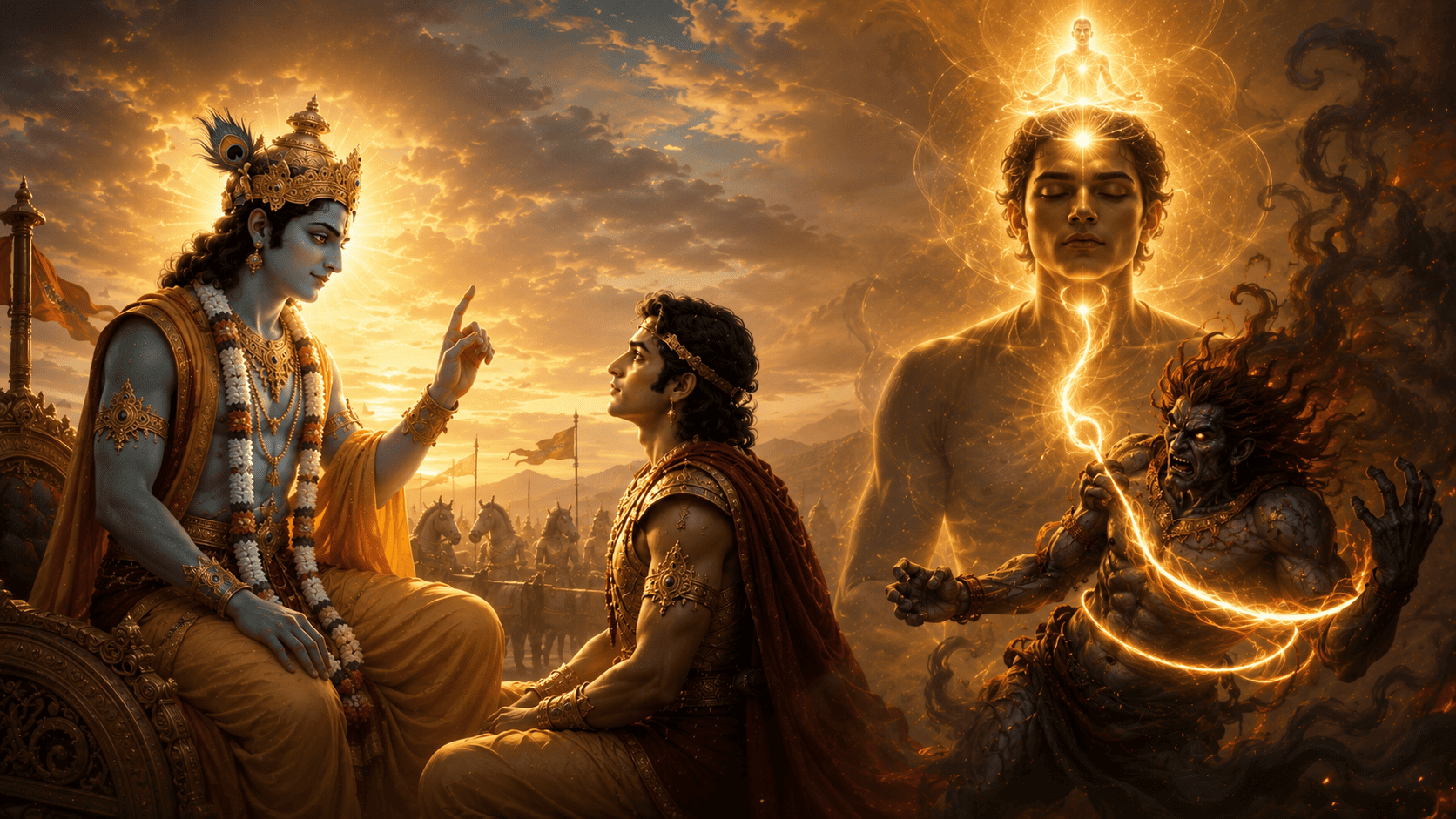
O mighty-armed Arjuna, knowing the Self to be superior even to the intellect, strengthen the mind through the power of the Self and conquer this formidable enemy in the form of desire.
Detailed Explanation
Realize the Supremacy of the Self
In this concluding verse of Chapter 3, Lord Krishna summarizes the essence of Karma Yoga.
He teaches that the Self (Ātman) is superior to the intellect, the mind, and the senses.
When a person realizes this higher spiritual identity, inner strength naturally develops, making it possible to overcome worldly desires and attachments.
Strengthen the Mind Through the Self
Lord Krishna advises Arjuna to steady and discipline the mind through the realization of the Self.
The mind often becomes restless because it is influenced by desires, emotions, and external attractions.
However, when it is guided by the wisdom of the Self, it becomes calm, disciplined, and focused on righteousness.
This inner mastery is the foundation of spiritual progress.
Desire – The Difficult Enemy
The Lord again identifies desire (Kāma) as the greatest enemy of spiritual life.
He calls it “durāsadam”, meaning an enemy that is extremely difficult to conquer.
Uncontrolled desire silently grows within the mind, giving rise to attachment, greed, anger, jealousy, and dissatisfaction.
Unless it is overcome, it continually obstructs wisdom and prevents true happiness.
The Power of Spiritual Discipline
Conquering desire is not achieved by force alone but through spiritual discipline.
Self-control, meditation, devotion, righteous living, and constant remembrance of God gradually weaken selfish desires.
As spiritual awareness increases, the mind becomes purified and attachment loses its influence.
The seeker then experiences greater peace, clarity, and freedom.
Karma Yoga in Practice
Karma Yoga teaches that every action should be performed without selfish attachment to its results.
When actions are dedicated to God and performed as one’s duty, personal desires slowly lose their hold over the mind.
Selfless service, devotion, meditation, scriptural study, and discrimination strengthen the intellect and help reveal the true Self.
This enables the seeker to conquer inner enemies and live with wisdom and equanimity.
The Final Victory
Lord Krishna concludes this chapter by reminding Arjuna that the greatest battle is not against external opponents but against the inner enemy of desire.
A person who conquers desire becomes the master of the senses, mind, and intellect.
Such mastery leads to spiritual freedom, unwavering peace, Self-realization, and ultimately liberation (Moksha).
Key Points
- The Self is superior to the intellect.
- The mind should be strengthened through Self-realization.
- Desire is the most difficult inner enemy.
- Spiritual discipline helps conquer selfish desires.
- Self-control purifies the mind and intellect.
- Karma Yoga reduces attachment to the fruits of action.
- Devotion, meditation, and wisdom strengthen inner awareness.
- Victory over desire leads to Self-realization and liberation.
- Inner conquest is greater than external victory.
Profound Spiritual Meaning
This verse presents the final teaching of Karma Yoga by revealing that true victory is achieved through mastery over oneself.
The Self is the highest reality within every individual and possesses the power to guide the intellect, mind, and senses toward righteousness.
Lord Krishna teaches that by realizing the Self, practicing selfless action, cultivating devotion, exercising self-discipline, and overcoming desire, a seeker transcends ignorance and attachment.
When the inner enemy of desire is defeated, divine wisdom shines without obstruction, leading to lasting peace, Self-realization, and ultimate liberation.
Word-by-Word Meaning
Evaṁ – Thus, in this manner
Buddheḥ – Than the intellect
Param – Superior
Buddhvā – Having understood, knowing
Sanstabhya – Steadying, controlling
Ātmānam – The mind, oneself
Ātmanā – By the Self, through inner strength
Jahi – Conquer, destroy
Śhatrum – The enemy
Mahā-bāho – O mighty-armed Arjuna
Kāma-rūpam – In the form of desire
Durāsadam – Difficult to conquer, formidable
Message of the Verse
Lord Krishna concludes the teachings of Karma Yoga by urging Arjuna to realize the supremacy of the Self and strengthen the mind through inner spiritual awareness. Desire is the most difficult enemy because it clouds wisdom and creates attachment and suffering. Through Self-realization, selfless action, devotion, meditation, discipline, and mastery of the mind, one can conquer desire, attain lasting inner peace, realize the true Self, and ultimately achieve liberation (Moksha).