
Chapter 1 – Arjuna’s Despondency
Verse 21
Hrishikesham’, tadaa, vaakyam’, idam’, aah, maheepate,
SenyoH, ubhyoH, madhye, ratham’, sthaapay, me, achyut ||21||
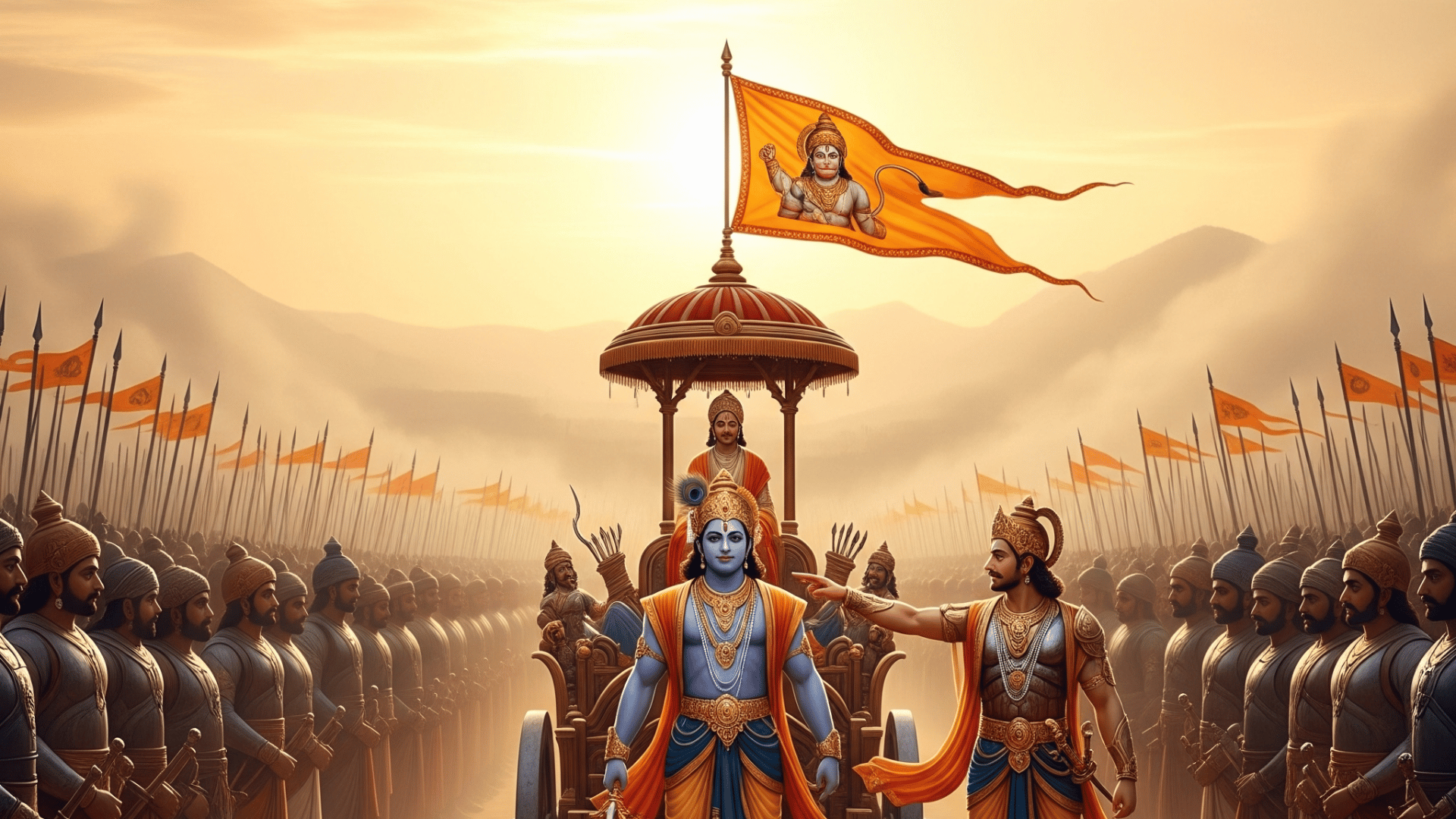
O King (Dhritarashtra)! At that moment, Arjuna—whose chariot bore the emblem of Hanuman—spoke these words to Lord Krishna, the master of the senses:
“O Achyuta (Infallible One)! Please place my chariot between the two armies.”
Deeper Interpretation / Detailed Explanation:
In this verse, before the battle begins, Arjuna requests Lord Krishna to drive his chariot between the two armies. His intention is to observe who he must fight against in the impending war.
This verse is not just a physical request—it carries deep spiritual symbolism:
- “Between the two armies” signifies that Arjuna stands at the threshold of a critical decision. He must choose between his duty (Dharma) and his emotional attachments (Moha).
- “Place my chariot, O Achyuta” — By addressing Krishna as Achyuta (the one who never falls or fails), Arjuna expresses his complete trust and surrender to Krishna’s divinity. It reflects both Krishna’s divine nature and Arjuna’s faith in Him.
This verse marks a turning point where Arjuna comes face to face with the harsh reality of war. It also signals the beginning of his inner turmoil and moral dilemma—known as Arjuna Vishada (Arjuna’s despondency)—which becomes the central theme of the Bhagavad Gita.