

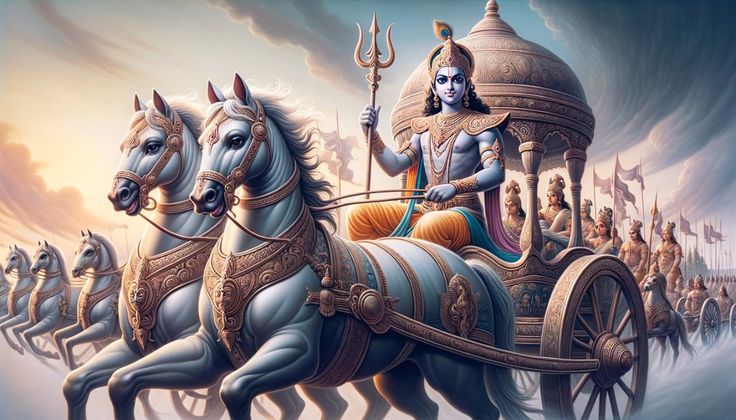
Chapter 2 – Sāṅkhya Yoga
Verse 12
na tvevāhaṁ jātu nāsaṁ na tvaṁ neme janādhipāḥ
na chaiva na bhaviṣhyāmaḥ sarve vayamataḥ param
Simple English Meaning:
Lord Shri Krishna said—
O Arjuna! There was never a time when I did not exist, nor you, nor all these kings; and there will never be a time in the future when we shall cease to exist.
Detailed Explanation:
Through this verse, Lord Shri Krishna begins to dispel Arjuna’s grief, fear, and mental confusion by revealing the eternal truth of the soul. Arjuna is overwhelmed by sorrow at the thought of destroying his relatives, teachers, and kings standing before him on the battlefield. Lord Krishna explains that this sorrow arises from ignorance of the true nature of existence.
The Lord clearly states that there was never a moment in the past when He Himself, Arjuna, or all these kings did not exist. Similarly, there will never come a time in the future when their existence will come to an end. Here, Lord Krishna is not speaking of the physical body, but of the soul.
The body is perishable—it is born and it dies—but the soul is unborn, eternal, and imperishable. Arjuna is grieving for what he believes will be destroyed, yet in reality, the soul can never be destroyed. Death is merely the end of the body, not of the soul.
With this verse, the central philosophy of the Bhagavad Gita begins—the immortality of the soul. Lord Krishna helps Arjuna understand that although bodies may perish in battle, the soul remains untouched. Therefore, grief based on bodily identification is misplaced and leads one away from one’s duty.
Word-by-Word Meaning:
- na tu eva aham – not indeed I
- jātu na āsam – was ever non-existent
- na tvam – nor you
- na ime janādhipāḥ – nor these kings
- na ca eva na bhaviṣyāmaḥ – nor shall we ever cease to exist
- sarve vayam ataḥ param – all of us shall exist forever hereafter
Profound Spiritual Meaning:
This verse answers one of the deepest questions of human existence— “Who am I?”
Lord Krishna reveals that human beings suffer because they identify themselves with the body, which is temporary, rather than with the soul, which is eternal.
Arjuna’s sorrow arises because he sees himself and others only as physical beings. Lord Krishna teaches that the soul transcends time, birth, and death. As long as a person remains identified with the body, fear, sorrow, and attachment will continue to dominate life. When one realizes the eternal nature of the soul, inner peace naturally arises.
From a spiritual perspective, this verse conveys that:
- The soul exists beyond past, present, and future
- Physical death is not the end, but a transformation
- Ignorance of the soul’s nature is the root of suffering
- Self-knowledge is the path to liberation
This verse marks the turning point in the dialogue between Guru and disciple, where ignorance begins to dissolve and divine wisdom starts to illuminate the path. This is why it is regarded as one of the most foundational verses of the Bhagavad Gita.
Message for Modern Life:
Even today, human beings struggle with fear, loss, and uncertainty about the future—just like Arjuna. This verse teaches us that when we identify ourselves solely with the body, possessions, or circumstances, suffering increases. Understanding the eternal nature of the soul brings stability, courage, and inner balance in life.