
Chapter 2 – Sankhya Yoga
Verse 16
nāsato vidyate bhāvo nābhāvo vidyate sataḥ
ubhayorapi dṛiṣhṭo ’nta stvanayos tattva-darśhibhiḥ
Simple Meaning in English
O Arjuna! That which is unreal never truly exists, and that which is real never ceases to be.
The true nature of both the real and the unreal has been clearly realized by the wise.
This means that the soul is eternal and imperishable, while the body and the material world are temporary.
One who understands this truth rises above pleasure and pain, fear, and attachment in life.
Detailed Explanation
In this verse, Lord Krishna imparts profound knowledge to Arjuna about the difference between the real and the unreal.
He explains that whatever is subject to destruction cannot be called truly real, while that which exists eternally is the real truth.
The body, emotions, pleasures, sorrows, and circumstances constantly change; therefore, they are unreal in the ultimate sense.
The soul, however, is never born, never dies, and is never destroyed—it is eternal and absolute truth.
The tattva-darshi (self-realized or enlightened beings) understand this truth not merely intellectually, but through direct experience.
Hence, they are not afraid of the destruction of the body, nor are they disturbed by the changing situations of life.
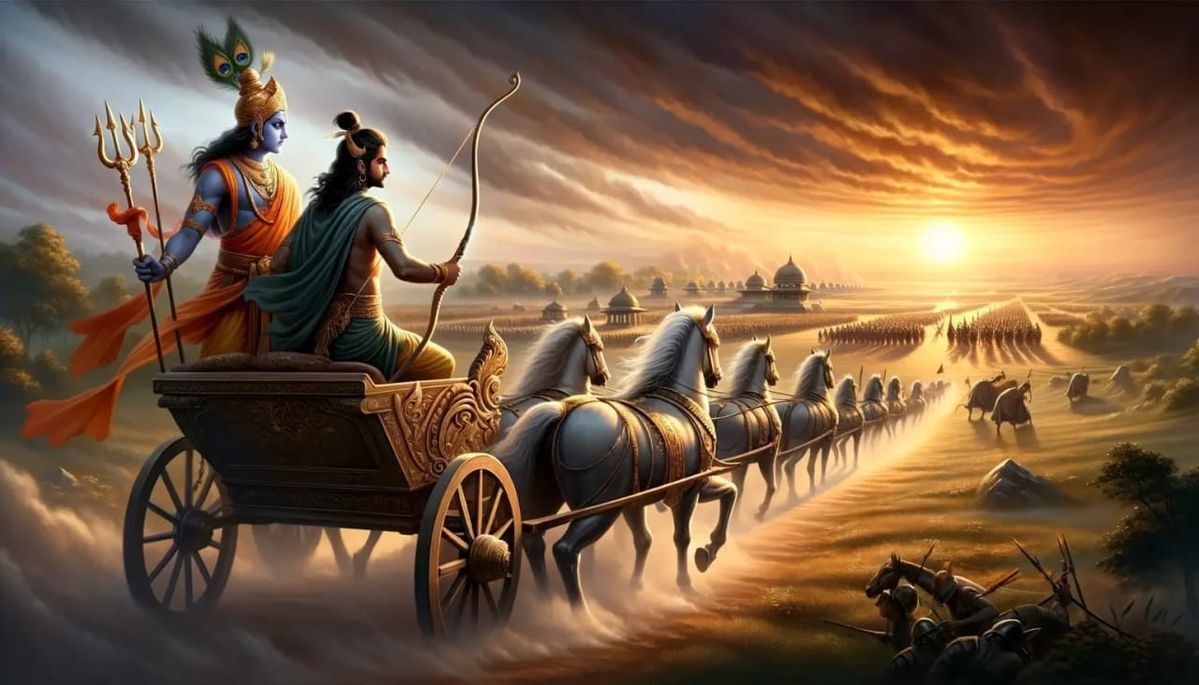
Lord Krishna explains to Arjuna that in war, the body may perish, but the soul never does.
The purpose of this verse is to remove Arjuna’s grief and confusion through true spiritual knowledge.
One who applies the wisdom of this verse in daily life
gives up attachment to perishable objects and becomes established in the eternal soul.
Such a person attains steady intellect, fearlessness, and inner spiritual freedom.
Word-by-Word Meaning
Na – not
Asataḥ – of the unreal
Vidyate – exists
Bhāvaḥ – existence
Na – not
Abhāvaḥ – non-existence
Vidyate – exists
Sataḥ – of the real
Ubhayoḥ – of both
Api – indeed
Dṛṣṭaḥ – seen, realized
Antaḥ – ultimate truth
Anayoḥ – of these two
Tattva-darśibhiḥ – by the seers of truth
Deep Spiritual Meaning
This verse is the foundation of self-realization.
It teaches us that we are not the body, but the pure and eternal soul.
Everything that appears in this world is subject to change and therefore cannot be the ultimate truth.
The soul alone is real—beyond time, death, and transformation.
When a seeker truly realizes this truth,
they are neither attached to pleasure nor broken by sorrow.
A deep and lasting peace arises within them.
This self-realization leads them toward freedom from the cycle of birth and death.
Through this verse, Lord Krishna does not ask Arjuna to withdraw from action,
but to become fearless through the knowledge of truth.
The message of this verse for all humanity is:
Transcending the perishable and realizing the eternal soul is true wisdom and the path to liberation (moksha).